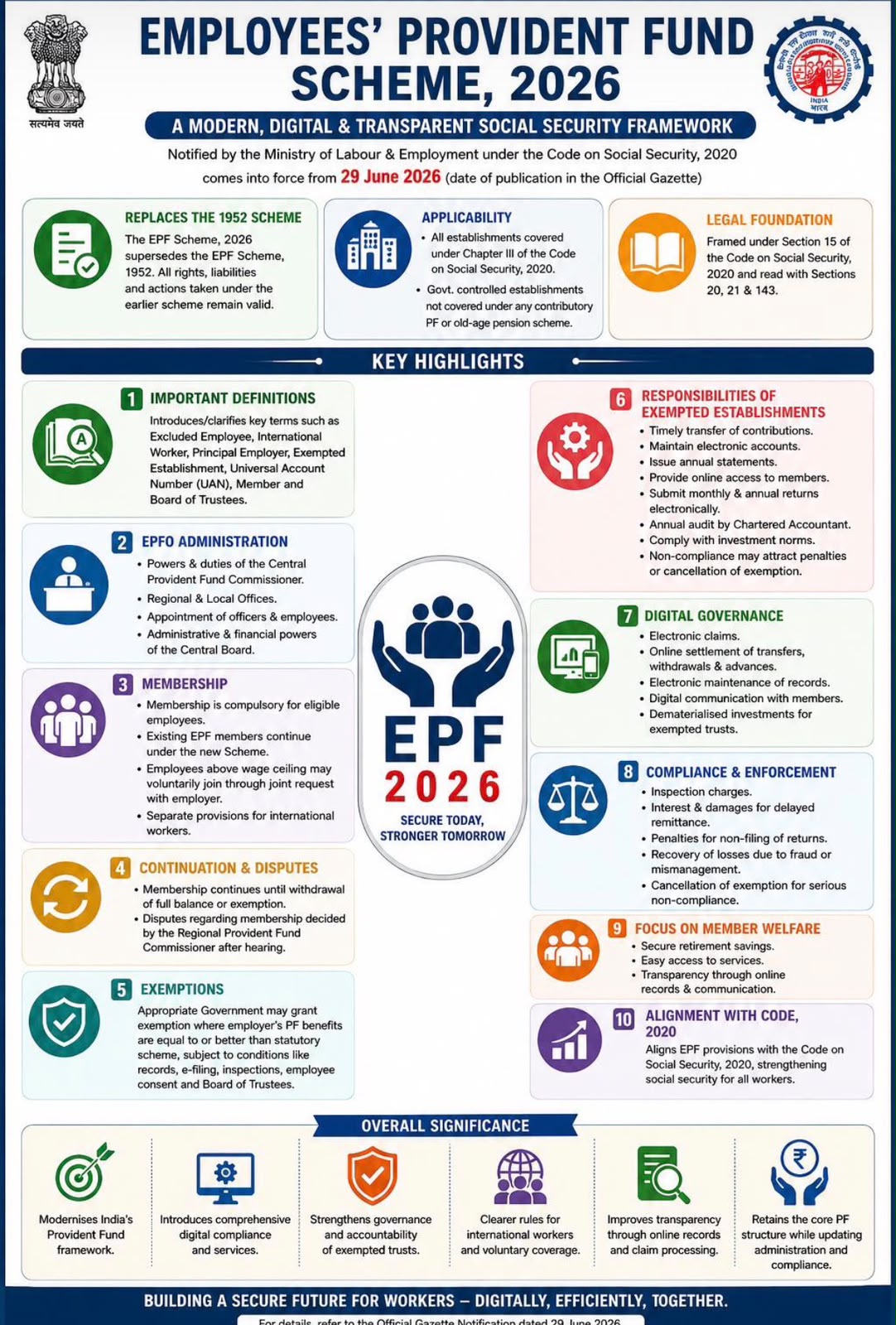
The Ministry of Labour & Employment has notified three new social security schemes under the Code on Social Security, 2020, with effect from 29 June 2026.
Client Compliance Advisory | August 2026
The Ministry of Labour &
Employment has notified three new social security schemes under the Code on
Social Security, 2020, with effect from 29 June 2026. These schemes
replace the earlier provident fund, pension and deposit-linked insurance
schemes and introduce a more consolidated, digital and compliance-focused
framework for employers and employees.
The three new schemes are:
|
New Scheme |
Replaces |
|
Employees’ Provident Funds Scheme, 2026 |
Employees’ Provident Funds Scheme, 1952 |
|
Employees’ Pension Scheme, 2026 |
Employees’ Pension Scheme, 1995 and earlier Family
Pension framework |
|
Employees’ Deposit-Linked Insurance Scheme, 2026 |
Employees’ Deposit-Linked Insurance Scheme, 1976 |
Existing EPF members continue
under the new framework, and their accumulated PF balances, memberships and
accrued rights are carried forward. The transition is therefore primarily a legal
and administrative modernisation rather than a reset of existing PF benefits.
1. PF
CONTRIBUTION STRUCTURE – ₹15,000 WAGE CEILING AND HIGHER-WAGE CONTRIBUTIONS
The basic contribution rate
remains 12% for the employee and 12% for the employer, subject to the
applicable statutory provisions.
The currently notified
statutory wage ceiling remains ₹15,000 per month. For employees whose
wages exceed this ceiling, the new framework formally clarifies the distinction
between mandatory contributions up to the ceiling and contributions on higher
wages.
Accordingly:
- Statutory PF contribution is calculated up to the
notified wage ceiling.
- For wages above ₹15,000, higher PF contribution can
continue where the employer and employee jointly opt for such
contribution.
- An employee may also voluntarily contribute more
than the statutory ceiling without creating a corresponding obligation on
the employer to match the excess, unless another applicable obligation
requires it.
- Employers should therefore review whether their
existing payroll policy provides for PF on actual basic wages or restricts
the contribution to the statutory ceiling.
Practical
implication for employers
Employers should not
automatically reduce existing PF contributions to ₹1,800 per month merely
because the new scheme has been introduced.
Where an organisation
currently contributes PF on actual basic wages exceeding ₹15,000, it should
first review:
- Existing employment terms and appointment letters;
- Company PF policy;
- Existing employee/employer practice;
- Any applicable settlement or agreement;
- Existing higher-wage contribution arrangements; and
- The documentation required for continuing
higher-wage contributions.
The new framework makes
higher-wage contribution arrangements more explicit and should be incorporated
into the organisation's payroll governance and documentation process.
Recommended action: Complete a
payroll impact assessment before finalising the July 2026 wage-month
contribution and subsequent ECR filings.
2.
ELECTRONIC RECORD-KEEPING AND REPORTING
The 2026 framework
significantly strengthens electronic compliance.
Employers are required to
maintain prescribed employee and contribution records electronically and submit
prescribed returns through the designated electronic system. Monthly electronic
returns are required within the prescribed timeline, including reporting of
employees who become eligible for EPF membership.
Recommended
action
Organisations should conduct
an EPF digital compliance audit covering:
- Employee master data;
- UAN and Aadhaar/KYC records;
- Date of joining and exit;
- Wage and contribution records;
- ECR filings;
- Contractor/contract labour records;
- International Worker records, where applicable;
- Nomination details;
- Electronic employee statements and access;
- PF reconciliation between payroll, ECR and
accounting records.
Any manual or fragmented
process should be identified and progressively migrated to a controlled
electronic workflow.
3.
ADDITIONAL RESPONSIBILITIES FOR EXEMPTED PF TRUSTS
Organisations operating
exempted PF trusts should pay particular attention to the enhanced governance
and compliance requirements.
The new framework places
greater emphasis on:
- Electronic maintenance and reporting;
- Proper accounting and member records;
- Investment compliance;
- Audit and governance;
- Timely reporting and reconciliation; and
- Continued compliance with exemption conditions.
In addition, the Government
has introduced an AMNESTY Scheme, 2026 providing certain establishments
operating PF trusts without formal EPFO exemption approval an opportunity to
regularise their status, subject to prescribed conditions. The scheme is available
for six months from notification.
Recommended action: Exempted
establishments should immediately review their exemption status, trust
documentation, investment compliance, member balances, accounting records and
audit position.
4.
INTERNATIONAL WORKERS – UPDATED COMPLIANCE REQUIREMENTS
The new EPF framework
continues to provide specific provisions for International Workers (IWs).
Employers should review their
expatriate and cross-border employee population to determine whether any
employees qualify as International Workers and whether an exemption under an
applicable Social Security Agreement is available.
Employers are also required to
electronically maintain and report relevant International Worker information,
including nationality, wages, contributions, membership status and exit
details.
Recommended action: Conduct an
International Worker compliance review wherever the organisation employs
foreign nationals or employees covered by applicable Social Security Agreements.
5. PRINCIPAL
EMPLOYER AND CONTRACT LABOUR COMPLIANCE
The new framework also
strengthens the compliance responsibilities of principal employers in relation
to contract workers.
Where applicable, principal
employers and contractors have specific reporting and information-sharing
obligations relating to contractual employees, including details such as UAN,
wages and contributions.
This makes contract labour
PF reconciliation an important area for HR, payroll, finance and
procurement teams.
Recommended action: Employers
should reconcile:
Contractor manpower →
Attendance → Wage sheet → PF contribution → ECR → Payment → Contractor invoice
on a monthly basis.
6. CLAIM
SETTLEMENT TIMELINE
The existing principle that PF
claims are required to be processed within 20 days continues to be
reflected in the EPFO framework.
For employers, this reinforces
the importance of maintaining accurate employee records, KYC, nomination and
exit information so that employee claims are not delayed because of incomplete
or inconsistent employer-side data.
Recommended action: HR teams
should establish a periodic review mechanism for:
- UAN/KYC status;
- Bank account details;
- Nomination;
- Date of joining;
- Date of exit;
- PF transfer records; and
- Pending employee corrections.
7. EMPLOYEE
NOMINATION – AN IMPORTANT HR ACTION POINT
One of the important areas
requiring HR attention under the new framework is PF nomination.
Organisations should review
existing employee nomination records and communicate the need for employees to
ensure that their nominations are valid and updated in accordance with the new
framework.
This is particularly important
following events such as:
- Marriage;
- Birth/adoption of children;
- Change in family circumstances; or
- Death of a nominee.
Recommended action: Consider
conducting an organisation-wide PF Nomination Update Drive through the
employee self-service/UAN platform.
8. NEW
WITHDRAWAL FRAMEWORK
The 2026 framework also
rationalises PF withdrawal provisions.
Partial withdrawals continue
to be available for specified purposes, subject to prescribed conditions. The
new framework provides for partial withdrawal after the required membership
period while requiring a minimum balance to remain in the account. Complete
withdrawal is also subject to specified circumstances and waiting requirements.
Accordingly, employees should
not assume that all historical withdrawal conditions remain identical under the
new framework.
Employers should update
employee FAQs, HR helpdesk material and onboarding/separation communication
accordingly.
KEY ACTION PLAN FOR EMPLOYERS
We recommend that
organisations undertake the following actions during the transition:
Immediate –
Payroll & Compliance
1. Review PF contribution
methodology
Confirm whether PF is being
calculated on:
- Statutory wage ceiling; or
- Actual eligible wages above the ceiling.
Document the basis and obtain
the required consent/option where applicable.
2. Validate July 2026 payroll
Reconcile employee
contribution, employer contribution, EPS and EDLI components before completing
the relevant ECR/payment cycle.
3. Review employee master data
Verify UAN, Aadhaar/KYC, bank
account, date of joining, date of exit and nomination records.
Within 30–60
Days
4. Conduct an EPF compliance
audit
Review payroll, ECR,
contribution, accounting and employee records.
5. Review contractor
compliance
Reconcile contractor manpower
and PF contributions with payroll/ECR records.
6. Review International Worker
compliance
Identify applicable employees
and verify Social Security Agreement/exemption requirements.
7. Review PF trust compliance
For exempted establishments,
verify exemption status, audit, investments, member records and statutory
reporting.
Strategic HR
Action
8. Review CTC and salary
structures
Assess whether the
organisation's PF policy and salary structure remain aligned with the new
contribution framework.
9. Update HR policies and SOPs
Revise:
- PF Policy;
- Payroll SOP;
- Joining documentation;
- Exit/separation checklist;
- Employee nomination process;
- Contractor compliance SOP; and
- Employee communication material.
IMPORTANT COMPLIANCE NOTE
The introduction of the EPF
Scheme, 2026 does not mean that every employer must automatically shift all
employees to a ₹15,000 PF wage base.
The statutory wage ceiling
remains ₹15,000, but the new framework expressly addresses contributions above
that ceiling and permits higher-wage contribution arrangements subject to the
applicable requirements and documentation. Employers should therefore assess
their existing contractual and payroll practices before making any unilateral
change.
Similarly, the 2026 framework
should not be viewed solely as a change in PF deduction. It introduces wider
requirements covering digital records, reporting, contract labour,
International Workers, nominations, withdrawals and exempted PF trusts.
CONCLUSION
The new provident fund
framework represents a significant step toward a more integrated, digital and
accountable social-security system in India.
For employers, the immediate
priority should be to ensure that payroll, HR, finance, PF administration
and contractor-management processes are aligned with the 2026 framework.
We recommend that
organisations complete a structured PF compliance review covering contribution
methodology, employee records, ECR filings, nominations, contract labour,
International Workers and, where applicable, exempted PF trusts.
We will continue to monitor
further notifications, EPFO circulars, FAQs and clarifications issued under the
new framework and recommend that organisations review their processes as
further operational guidance becomes available.
For any clarification or
assistance in assessing the impact of the 2026 PF framework on your
organisation, please feel free to contact the undersigned.
Disclaimer: This
advisory is intended for general compliance awareness and should be read
together with the applicable Gazette notifications, EPFO directions and
organisation-specific facts. Employers should obtain professional advice before
making material changes to their existing PF contribution or contractual
arrangements.